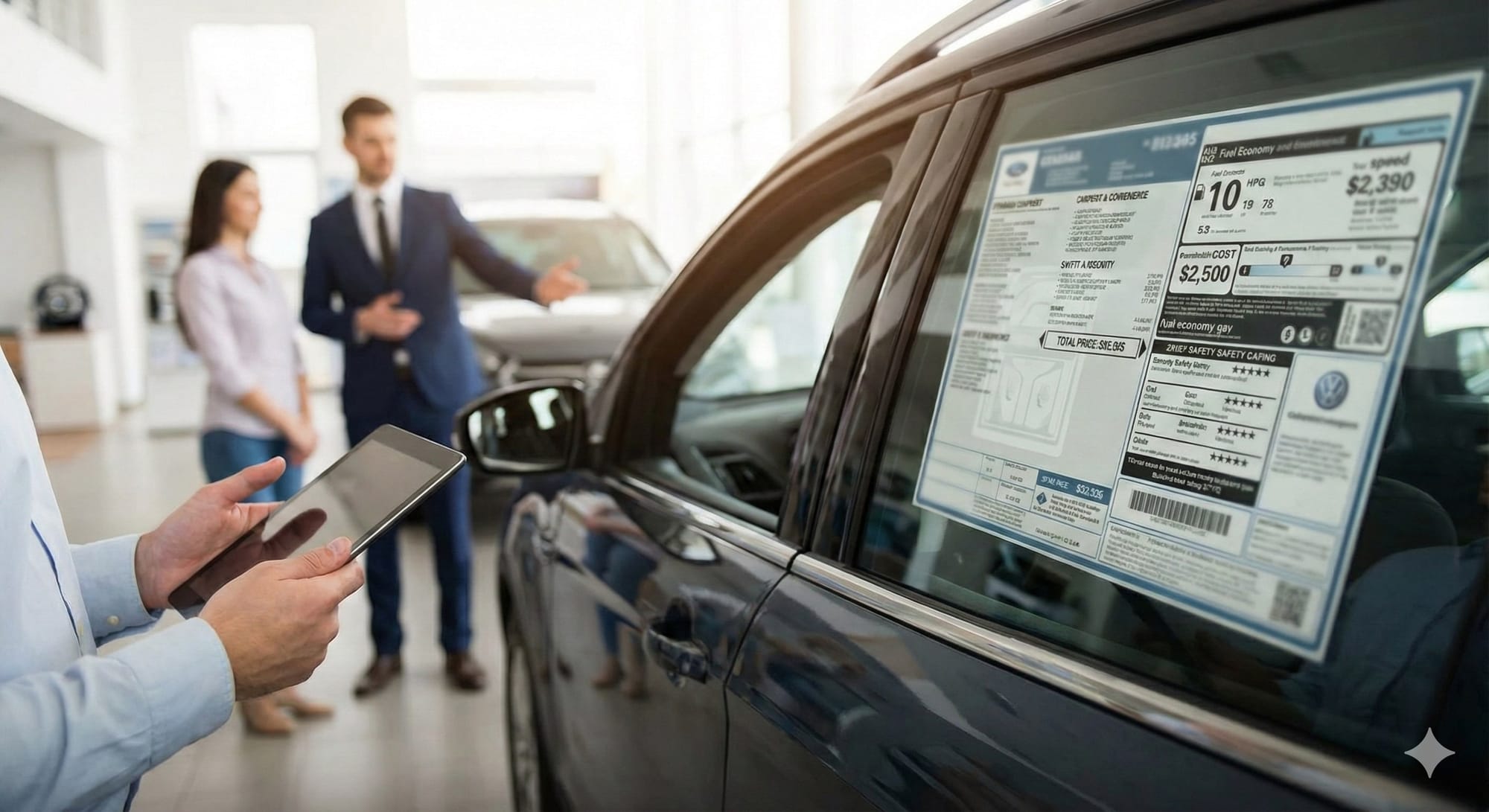
Walk onto any dealer's lot and you'll find two labels on the same car: the factory window sticker, and a second sheet the dealership added itself. Both use numbers, both sit in the window, and most shoppers never learn to tell them apart. That mix-up is exactly what makes a dealer's addendum easy to slip past you.
This guide covers what dealers actually do with window stickers during a sale, how to read the addendum sticker most dealers add on top, and how to use the same information dealers have to negotiate from a position of knowledge instead of guesswork.
The Role of Window Stickers in Car Dealerships
The factory window sticker — officially the Monroney label — arrives on the car from the manufacturer and can't legally be removed before the sale. It lists the trim, every factory-installed option with its own price, the destination charge, EPA fuel economy, and the base and total MSRP. Dealers use it as their starting reference point for every new car on the lot: it's the one document that says, in writing, exactly what the manufacturer built and what the manufacturer says it should cost.
What the sticker does not do is set the price you'll actually pay. MSRP is a suggestion, not a legal ceiling or floor — dealers are free to sell above it, below it, or exactly at it. That's where the second sticker comes in.
Understanding Dealer Addendum Stickers
What is a dealer addendum?
A dealer addendum (sometimes called a supplemental sticker) is a separate label the dealership adds next to the factory window sticker. Unlike the Monroney label, it isn't federally mandated and isn't standardized — each dealer designs their own. It typically lists dealer-installed accessories, a market adjustment, or both, each with its own price added on top of the factory MSRP.
Market adjustments and ADM
"Market adjustment" and "ADM" (Additional Dealer Markup) both mean the same thing: a flat amount the dealer tacks on above MSRP, usually justified by high demand for a specific model. There's no formula behind the number — it's whatever the dealer believes the market will bear. On popular or supply-constrained vehicles, an ADM line can add thousands of dollars with nothing to show for it beyond the dealer's own pricing decision.
Dealer-installed options
These are physical add-ons the dealership installs after the car arrives — paint sealant, fabric protection, window etching, nitrogen-filled tires, wheel locks, and similar items. Some buyers genuinely want these; most are marked up well beyond what they'd cost from an independent shop, and several (sealant, fabric protection) are close to pure profit with minimal material cost.
Mandatory vs. optional add-ons
The distinction that matters most: anything on the addendum sticker is negotiable, because the dealer put it there. Some dealers present certain items as "mandatory" or "already installed" to discourage haggling, but a dealer-added option is never a factory requirement the way anything on the actual Monroney label is. If it's not on the factory sticker, it was a business decision, not a manufacturer mandate — and business decisions can be renegotiated or removed.
Using Window Stickers to Your Advantage
Knowing true MSRP and options
Before you can spot a markup, you need the real number to compare against. Pull the window sticker for the exact VIN you're looking at — not a generic price you saw online for "that model" — since options change the total MSRP significantly from one unit to the next. If the paper sticker is gone, you can recover it by VIN in minutes.
Identifying dealer markup
Add up every line on the factory sticker. Whatever the dealer is asking above that total — market adjustment, addendum items, anything not printed by the manufacturer — is markup. Naming it out loud in a conversation ("I see $52,310 on the Monroney label and you're asking $58,000 — walk me through the difference") puts the burden on the dealer to justify each line instead of you having to guess what's fair.
Negotiation strategies
Negotiate the addendum separately from the car itself. Dealers expect pushback on markup and dealer-installed options; they're far less willing to move on the factory MSRP itself. Ask for each addendum line to be removed or reduced one at a time rather than requesting a single lump discount, which is easier for a salesperson to reject outright.
When to walk away
If a dealer won't budge on an ADM for a vehicle that isn't genuinely rare, or presents dealer-installed options as non-negotiable, that's a signal, not a dead end — the same car, or something close to it, is very likely available at another dealership without the same markup. Walking away costs you nothing and is often what actually gets a call back with a better number.
Red Flags on Dealer Window Stickers
Excessive market adjustments
A modest ADM on a genuinely limited-availability vehicle isn't unusual. A large adjustment on a common trim of a common model, with no real scarcity behind it, is a sign the dealer is simply testing what you'll pay.
Mandatory dealer add-ons
Some dealers install low-cost items (nitrogen tires, VIN etching, paint protection) on every car on the lot and frame them as non-removable. They're removable — the dealer chose to install them, which means the dealer can choose to discount or waive them.
Misrepresented options
Occasionally an addendum or a salesperson's description implies a factory option that isn't actually on the Monroney label. The factory sticker is the tiebreaker: if a listed feature doesn't appear on it, it didn't come from the manufacturer, whatever the addendum or sales copy claims.
Hidden fees and charges
Documentation fees, dealer prep charges, and similar line items sometimes appear only at the finance desk rather than on either sticker. Ask for the full out-the-door price in writing before you sit down to sign, so nothing new shows up after you've already committed mentally to the deal.
Dealer Window Sticker FAQs
Is a dealer addendum sticker legal?
Yes. Dealers are legally allowed to charge above MSRP and to add their own pricing sticker, as long as the original factory Monroney label stays in place and isn't altered. What's not legal is removing or covering the manufacturer's label before the sale.
Do I have to pay the dealer markup?
No. Market adjustments and dealer-installed options are set by the dealership, not the manufacturer, which means they're negotiable in the same way the rest of the deal is. Whether a dealer agrees to remove them depends on demand for that specific vehicle and how willing they are to lose the sale.
Can I get the window sticker before I visit the dealership?
Yes, if you have the VIN. Look it up in advance so you're comparing the dealer's price against the real factory numbers before you're sitting across the desk, not after.
What's the difference between the window sticker and the price I actually pay?
The window sticker shows MSRP — the manufacturer's suggested price. What you pay is negotiated between you and the dealer, and can land above or below that number depending on demand, markups, and how the negotiation goes. For a full breakdown of what MSRP does and doesn't guarantee, see our MSRP guide.
Know Before You Go to the Dealer
Get the window sticker in advance
Do this before you set foot on the lot, not during the negotiation. Pull the window sticker by VIN for the exact car you're considering, and treat every number the dealer quotes as something to check against it.
Research fair pricing
Compare the factory MSRP against current market data for that model and trim. A car in high demand may reasonably sell near or above MSRP; a car sitting on the lot for months usually shouldn't.
Negotiate from a position of knowledge
The single biggest advantage a prepared buyer has is knowing, line by line, what's factory and what's dealer-added. Walk in with the Monroney label already in hand, and every addendum item becomes a specific, answerable question instead of a number you either accept or don't.
Tags
Found this useful?
Prefer Monroney Decals as a source on Google to see more of our content in Search.