A window sticker and a build sheet both describe how a vehicle left the factory, so people often treat them as the same thing. They are not. The window sticker is the public, legally required label with prices and ratings. The build sheet is the factory's own production record, written in option codes. This guide shows what each one contains, which one answers your question, and how to get it.
Quick Answer
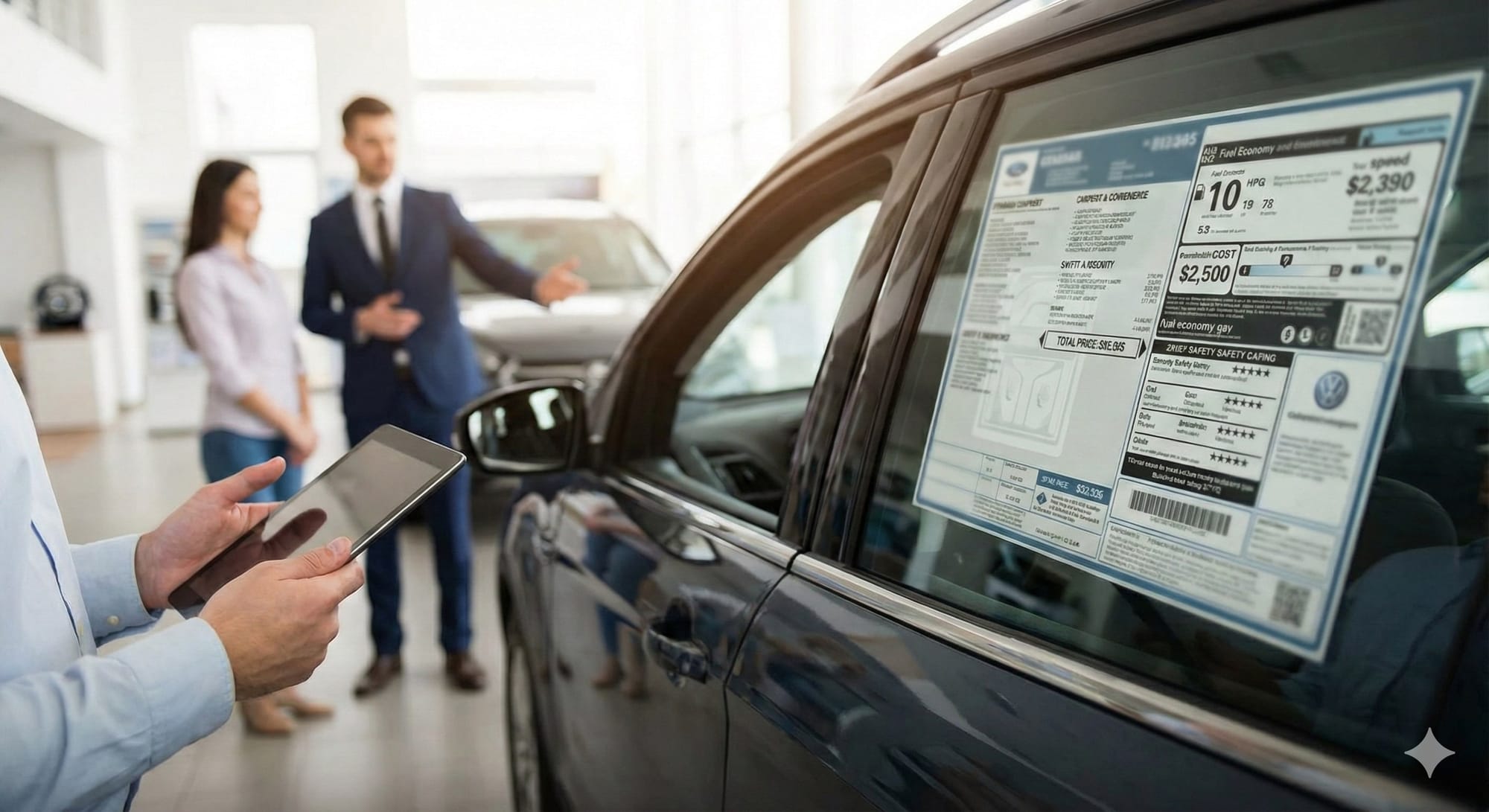
- Window sticker (Monroney label): the label a manufacturer must put on every new car sold in the United States. It lists standard and optional equipment in plain language, the price of each option, the total MSRP, EPA fuel economy, and safety ratings.
- Build sheet: an internal manufacturer document that tells the assembly plant how to build one specific vehicle. It lists option codes, paint and trim codes, and production details. It normally has no prices and no EPA or safety information.
If you want to know what a vehicle came with and what it cost new, you want the window sticker. If you need exact factory codes for a restoration or a parts order, you want the build sheet.
What a Window Sticker Is
The window sticker is officially called the Monroney label. Federal law, the Automobile Information Disclosure Act of 1958, requires it on new passenger vehicles so that buyers can compare cars on the same terms. Because it is written for buyers, it is designed to be read by someone who has never seen an option code. For the full legal background, see our guide on what a Monroney label must contain.
A window sticker shows:
- Year, make, model, trim, engine, transmission, and exterior and interior colors
- Standard equipment included at that trim level
- Optional equipment and packages, each with its own price
- Base price, destination charge, and total MSRP
- EPA fuel economy, or range and MPGe on electric vehicles
- NHTSA safety ratings, where the vehicle has been tested
- Where the vehicle was assembled and where its major parts came from
What a Build Sheet Is
A build sheet is a production document. Before a vehicle is assembled, the manufacturer creates a record of every choice that defines it: body style, engine, transmission, axle, paint, interior trim, and each option. On the line, that record tells workers and machines which parts to install. It was never meant for buyers, and no law requires a manufacturer to hand it to one.
Most of a build sheet is written in codes. General Motors, for example, uses three-character Regular Production Option (RPO) codes, where one short code can stand for an engine, an axle ratio, or a paint color. Other manufacturers use their own code systems. You usually need a decoding reference to turn a build sheet into plain language.
The format has changed over time. On many older American cars, a paper sheet travelled with the car down the assembly line, and restorers still find these tucked under seats or above fuel tanks. Today the same information lives in the manufacturer's database, and a dealer can often print it as a list of the vehicle's option codes.
Window Sticker vs Build Sheet: Side by Side
| Window sticker | Build sheet | |
|---|---|---|
| Written for | Car buyers | The assembly plant |
| Required by law | Yes, on new vehicles sold in the US | No |
| Language | Plain descriptions | Mostly option codes |
| Option prices and MSRP | Yes | Normally not |
| EPA and safety ratings | Yes | No |
| Paint, trim, and axle codes | Color names, rarely the codes | Yes |
| Production details | Assembly location | Plant, sequence, and scheduling data, depending on the maker |
| Best for | Buying, selling, and valuing a vehicle | Restoration, parts matching, and authenticity checks |
What Only the Window Sticker Tells You
Price is the big one. A build sheet can tell you a truck has a towing package, but only the window sticker tells you what that package cost new (say, $1,500) and what the whole vehicle listed for. That matters when you are judging whether a used price is fair, because two vehicles that look identical can differ by thousands of dollars in original options. Our guide to MSRP on a window sticker explains how to read those pricing lines.
The window sticker is also the only one of the two with EPA fuel economy and government safety ratings, and it groups options into the named packages that sellers and buyers actually talk about.
What Only the Build Sheet Tells You
The build sheet goes deeper on hardware. It can show the exact axle ratio, the paint code instead of the marketing color name, the interior trim code, and items that had no separate price and so never appeared as a line on the window sticker. For a collector checking that a car is a genuine high-performance model and not a later conversion, those codes are the evidence that counts.
Which One Do You Need?
- Buying a used car: the window sticker. It confirms the trim, the factory-installed packages, and the original MSRP, so you can check the listing against what the factory built.
- Selling a car: the window sticker. Buyers understand it at a glance, and it documents the options you are asking them to pay for.
- Ordering parts or matching paint: the build sheet or the vehicle's option code list, because parts catalogs are organized by code.
- Restoring or authenticating a classic: the build sheet, or a documentation service for that brand.
- Checking for accidents or title problems: neither. That is a job for a vehicle history report. See window sticker vs Carfax and window sticker vs title.
How to Get a Window Sticker
A window sticker is tied to the VIN, so it can be produced again long after the paper label is gone. Some automakers offer a free lookup for recent model years, a dealer can sometimes print one, and services like ours generate one from the VIN. We compare those routes honestly in free vs paid window sticker lookup, and the step-by-step guide to getting a window sticker by VIN walks through each one.
To be clear about what we provide: our window sticker is a reproduction of the original factory label, built from the manufacturer build record for your specific VIN. It is not the original piece of paper, and it is not a build sheet.
How to Get a Build Sheet
There is no single public source, and what you can get depends on the brand and the age of the vehicle. The usual routes are:
- A franchised dealer. The parts or service department can often look up a VIN and print the vehicle's option codes. Policies vary by dealer, and some will only do it for the owner.
- The manufacturer's customer service. Some will send build information to a verified owner on request.
- The vehicle itself. Many vehicles carry a label listing their option codes. On many GM vehicles this is the Service Parts Identification label. On older cars, the original paper build sheet is sometimes still hidden in the car.
- Brand documentation services for classics. For example, Marti Reports cover many classic Fords and PHS Historic Services covers Pontiacs. Coverage, fees, and model years differ, so check the service for your vehicle before you rely on it.
A VIN Decoder Is Neither
A free VIN decoder reads the 17 characters of the VIN itself. That gives you the manufacturer, model year, plant, body style, and usually the engine. It cannot tell you which optional packages were added or what the vehicle cost, because that information is not encoded in the VIN. A decoder is a good first check, but it does not replace either document.
Frequently Asked Questions
Is a build sheet the same as a window sticker?
No. A window sticker is the buyer-facing label required by federal law, with prices, fuel economy, and safety ratings. A build sheet is the factory's internal production record, written mostly in option codes and normally without prices.
Does a build sheet show the original MSRP?
Normally not. Build sheets record what to install, not what it cost. The original MSRP and the price of each option are on the window sticker.
Can I get a build sheet from a VIN for free?
Sometimes. A dealer's parts or service department may print the option codes for a VIN at no charge, especially for an owner, but there is no guarantee. Classic-car documentation services usually charge a fee.
Which is better when buying a used car?
The window sticker, in most cases. It confirms the trim and factory packages in plain language and shows the original MSRP, which is what you need to judge a listing and a price. A build sheet is more useful for restoration, parts, and authenticating collector vehicles.
Does every vehicle have a build sheet?
Every modern vehicle has a factory build record, but that does not mean a printed sheet exists or that the manufacturer will release it. Availability depends on the brand, the model year, and whether you are the owner.
Conclusion
The two documents describe the same vehicle for two different readers. The window sticker tells a buyer what the car has, what it cost, and how it rates. The build sheet tells the factory how to build it. For buying, selling, or valuing a vehicle, get the window sticker by VIN. For restoration and parts, look for the build sheet or the option code list.
Found this useful?
Prefer Monroney Decals as a source on Google to see more of our content in Search.
Related Guides
Kia Window Sticker by VIN
Get your Kia window sticker instantly. Factory-correct Monroney labels for all Kia models.
Mercedes-Benz Window Sticker by VIN
Get your Mercedes-Benz window sticker instantly. Factory-correct Monroney labels for all Mercedes-Benz models.
BMW Window Sticker by VIN
Get your BMW window sticker instantly. Factory-correct Monroney labels for all BMW models.
Related Articles

Car Window Sticker Explained
What's actually on a car window sticker, why it matters when buying or selling, and how to get one for any vehicle by VIN.

The Future of Window Stickers
The window sticker already went half-digital in 2013 with QR-code fuel economy data. Here's what's actually changed and where this realistically goes next.
How Dealers Use Window Stickers (And How You Can Too)
How car dealers use window stickers during sales, why they matter for pricing transparency, and how buyers can get their own copy by VIN.
Get Your Window Sticker Today
See the factory options, packages, and original MSRP for your VIN, in the factory-correct format.
Get Your Window Sticker Now