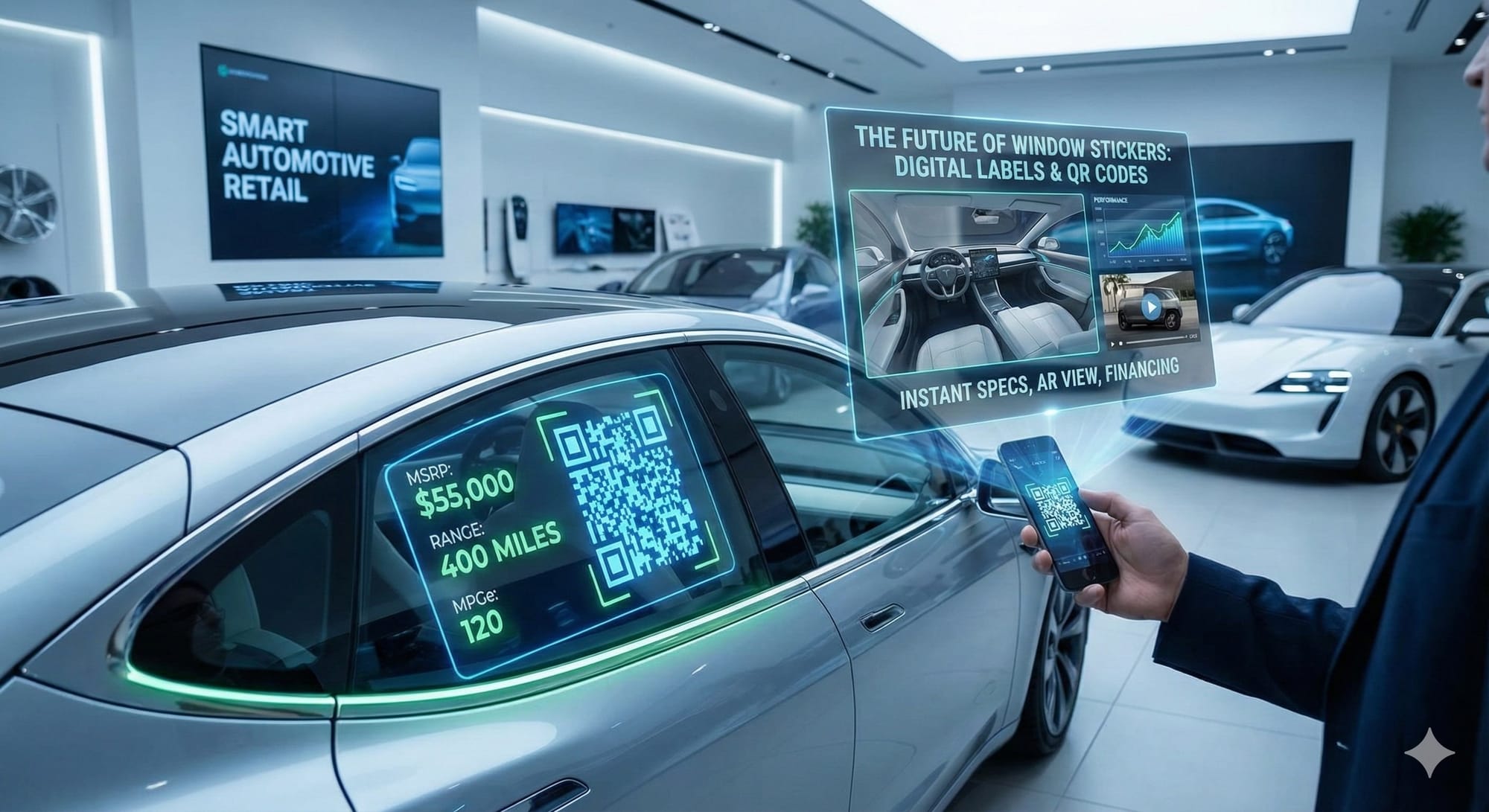
Stand in front of almost any new car today and you'll see two very different eras of disclosure side by side: a paper sticker printed with the same basic layout the government has required since 1958, and — since 2013 — a small QR code in the corner that pulls up a live webpage on your phone. The window sticker has already gone half-digital. The interesting question is what happens to the other half.
The QR Code Is Already Here
Most people assume "digital window stickers" is a future concept. It isn't — it's already been federal policy for over a decade. Starting with the 2013 model year, a joint rule from the EPA and NHTSA overhauled the Fuel Economy and Environment portion of the window sticker, and one of the biggest changes was the addition of a QR code. Scan it, and you're taken directly to fueleconomy.gov for that exact vehicle: detailed emissions data, cost-to-drive comparisons against similar models, and — for hybrids and EVs — range and charging information that a static printed number can't keep up with.
That's the part of the sticker that made the most sense to digitize first. Fuel prices change. EPA methodology gets refined. A QR code linking to a government database can stay current in a way that ink on paper never can.
Why the Paper Sticker Isn't Going Anywhere Soon
Here's the part that surprises people: the physical window sticker isn't a bureaucratic habit that regulators just haven't gotten around to modernizing. It's federal statute. The Automobile Information Disclosure Act of 1958 (15 U.S.C. §§ 1231–1233) requires that specific information be affixed to the vehicle itself before sale. Replacing that with a purely digital disclosure — a QR code and nothing else — wouldn't be a simple regulatory update from NHTSA. It would require Congress to amend the underlying law.
That's a meaningfully higher bar than most "the future is digital" predictions account for. Digital fuel-economy data was added because it supplemented the sticker, not because it replaced any part of what the statute requires. Don't expect the paper sticker itself to disappear until lawmakers, not just regulators, decide to act.
What's Already Digital Today
Outside of the fuel economy QR code, plenty of digital access already exists — it just isn't part of the sticker itself. Every major manufacturer's build-and-price tool shows the same specs and pricing structure a new sticker would. Many dealers can print or email a copy on request. And for used vehicles — where the original paper sticker is very often long gone — a Monroney label can be reconstructed digitally from the VIN alone, since the factory build data behind it never changes. That's the gap a window sticker lookup by VIN actually fills: not replacing the original sticker, but recovering the same information once the physical copy is gone.
Where This Could Realistically Go Next
A few extensions look more likely than a full digital replacement:
- QR codes covering more of the sticker, not just fuel economy. Extending the same live-data approach to safety recalls or updated EV range estimates would supplement the required disclosures without touching the statute.
- EV-specific dynamic data. Battery range and charging specs are exactly the kind of number that ages faster than a printed sticker can track — a natural candidate for the same treatment fuel economy already got in 2013.
- Better standardization of digital copies for used cars. As more of the used-car market moves online, having a consistent, verifiable way to pull up a vehicle's original build sheet by VIN matters more, not less.
What's unlikely: a fully paperless Monroney label appearing on a dealer's screen instead of the car's window, at least without an act of Congress most people aren't tracking.
Frequently Asked Questions (FAQ)
Is the QR code on my window sticker required by law?
Yes, for fuel economy and environmental data specifically. The 2013 EPA/NHTSA rule made the QR code (or an equivalent digital access point) a required part of that section of the sticker for new vehicles.
Can a dealer legally show me a digital sticker instead of a physical one?
No — federal law requires the physical label to be affixed to the vehicle before a new-car sale. A digital copy can supplement it, but it doesn't satisfy the legal requirement on its own.
What happens to the physical sticker after I buy the car?
Nothing requires you to keep it, and most get removed or lost. That's fine — the information it contained doesn't change, which is why it can be regenerated from the VIN years later for resale, insurance, or simple curiosity.
Will older, pre-2013 vehicles ever get a digital fuel economy label?
No — the QR code requirement applies to model year 2013 and later. Older vehicles' original stickers simply predate the rule.
The Bottom Line
The window sticker didn't wait for some hypothetical digital future — part of it already made the jump in 2013, for exactly the kind of data that benefits from staying current. The rest is anchored by federal statute, not inertia, so don't expect the paper to vanish anytime soon. What's genuinely useful right now isn't waiting for further digitization — it's being able to pull up that same factory information for any vehicle, new or decades old, whenever you actually need it.
Need a copy for a specific vehicle? Look up your factory-correct window sticker by VIN and get an instant PDF.
Tags
Found this useful?
Prefer Monroney Decals as a source on Google to see more of our content in Search.